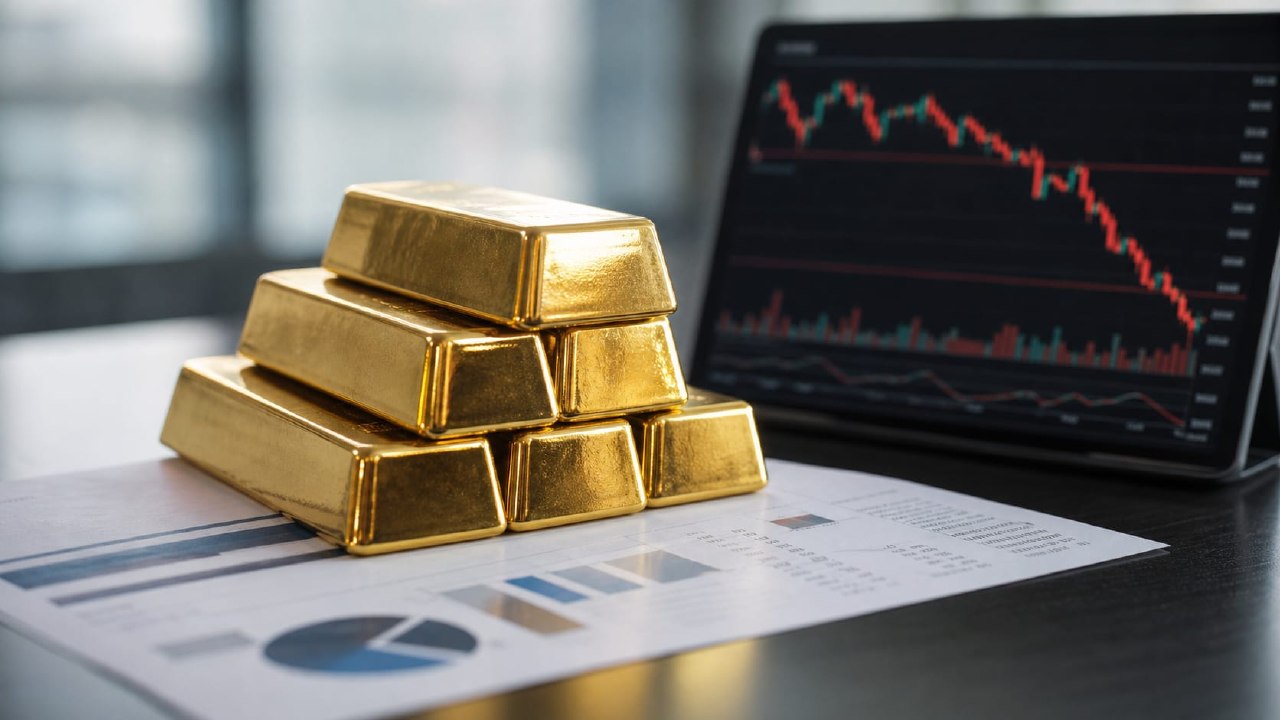
Gold Slips as Fed Hike Risk Starts Beating the Peace Trade
Gold fell below $4,200 as the dollar strengthened and traders focused less on oil relief and more on the risk that the Fed may need to raise rates again.
Listen to this update
Ready when you are.
Quick takeaway
Gold is still getting some help from calmer oil headlines, but today the market is treating Fed rate-hike risk as the bigger force.
What happened
Gold moved lower again on Tuesday, and the reason matters more than the size of the drop.
Barron's reported gold futures down 1.7% to $4,129.10 an ounce in early New York trading on June 23, with the U.S. dollar index slightly firmer. MarketWatch also pointed to gold futures near $4,140 as Deutsche Bank argued that the recent pressure is coming less from energy prices and more from expectations that the Federal Reserve may have to raise rates again.
That is a change in the market's focus. Peace-talk optimism around U.S.-Iran headlines can reduce oil-shock fear, which would normally help the inflation story. But gold did not get much relief from that today because the rate story took over.
Why the Fed story is overpowering oil relief
Gold does not pay interest. That is why rate expectations matter so much. When investors think the Fed could raise rates, cash and bonds look more competitive, the dollar can strengthen, and the cost of holding gold becomes harder to justify.
Deutsche Bank's Michael Hsueh framed the latest selloff around Fed repricing and resilient U.S. macro data. In MarketWatch's summary, Deutsche Bank's base case still sees gold reaching $4,800 an ounce in the fourth quarter if the Fed stays on hold. But the risk case is much rougher: if markets price three to four Fed hikes, the bank warned gold could fall toward $3,800.
That does not mean $3,800 is the forecast. It means the market has a clear pressure point now. If rate-hike expectations keep rising, gold has to lean harder on central-bank demand, portfolio insurance, and long-term scarcity to offset the drag from yields and the dollar.
ETF flows and Asia demand add to the pressure
The rate story is not happening in isolation. The Economic Times reported that Deutsche Bank also flagged ETF selling and weaker demand from China and India as part of the pressure on bullion.
That combination matters because gold rallies are easier to sustain when financial investors and physical buyers are both active. When ETF flows soften and physical buyers wait for calmer prices, the market has less cushion against a stronger dollar or a hawkish Fed repricing.
World Gold Council data for May already showed global gold ETF flows slowing sharply after stronger activity earlier in the year. That does not erase the longer-term gold case, but it does make the near-term market more sensitive to rate headlines.
What this means for readers
Today's useful lesson is that gold can fall even when geopolitical stress is not fully gone. The metal is not only a fear trade. It is also a rates trade, a dollar trade, and a liquidity trade.
For readers using gold as a valuation reference, the key question is whether the market keeps treating $4,100 to $4,200 as a temporary rate scare, or whether Fed-hike pricing starts pulling gold closer to the $4,000 area again.
Watch whether gold can regain the $4,200 area after today's drop.
Watch whether Fed speakers reinforce or cool the rate-hike narrative.
Watch ETF flows and Asian physical demand for signs that buyers are stepping back in.
Watch the June 25 PCE-related release, because it can change the inflation and rate conversation quickly.
What to watch next
The next clean catalyst is the inflation and income data scheduled for later this week. If the data weakens, gold may get a better argument that the Fed can stay on hold. If it stays firm, today's pressure could look less like a one-day reaction and more like a repricing around higher rates.
For now, the signal is straightforward: oil relief helped calm part of the market, but it did not rescue gold from the Fed.