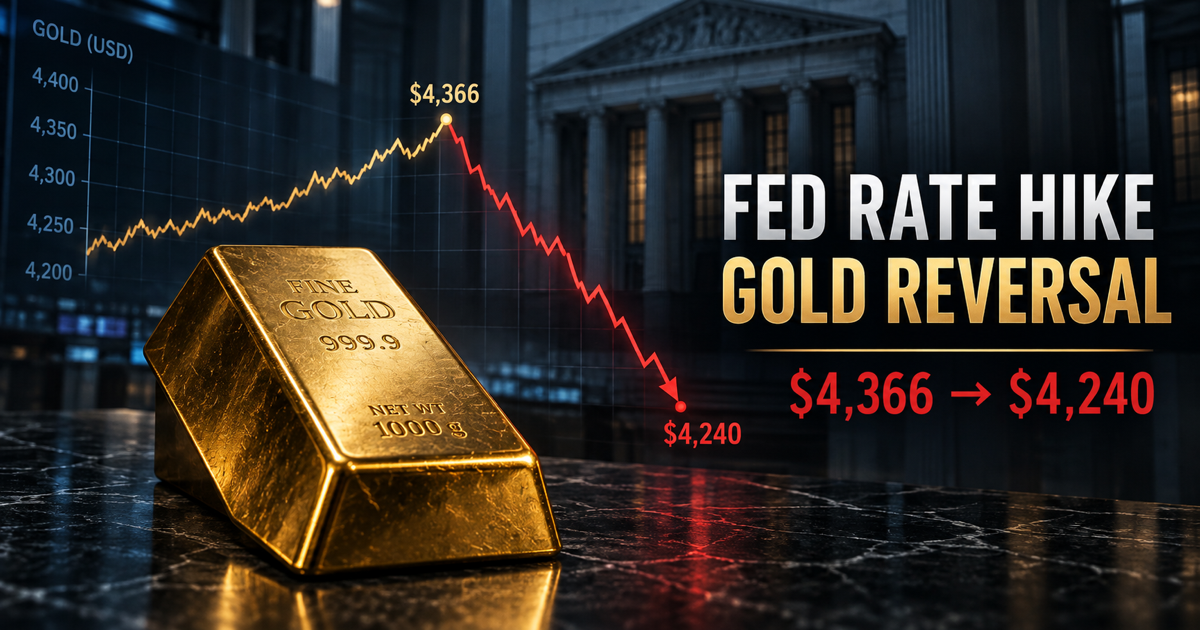
Gold Reverses $125 as Fed's First Rate Hike Since 2023 Signals More Tightening
Bullion swung from a session high near $4,366 to about $4,240 after the Fed raised rates and projected another increase, making the future policy path the market's new valuation test.
Listen to this update
Ready when you are.
Quick takeaway
Gold's pre-decision rally unraveled after the Federal Reserve delivered its first rate increase since 2023 and projected a more restrictive path than in June. Spot bullion moved from a session high of $4,365.57 to about $4,240.10 by 3:10 p.m. ET, a reversal of roughly $125 per ounce. The quarter-point hike itself was widely anticipated; the stronger signal was the Fed's 4.1% median end-2026 rate projection and a dot plot in which 16 of 18 participants showed at least one more increase this year. That outcome confirms the valuation channel identified before the meeting: when expected rates, the dollar and real yields rise together, their opportunity-cost pressure can overpower gold's inflation-hedge demand in the short run.
A morning rally became a $125 reversal
Gold climbed more than 1% before the policy announcement and reached $4,365.57 per ounce as softer oil prices and lower long-term Treasury yields supported bullion. The move showed that investors had largely prepared for a quarter-point increase and were positioned for the possibility of measured guidance.
That interpretation changed after the decision and press conference. Spot gold was down 1.2% at $4,240.10 by 3:10 p.m. ET, reversing roughly $125 from the session high as the dollar strengthened and traders absorbed the prospect of further rate increases.
The reversal is more informative than either side of the intraday move alone. Gold first rallied through the anticipated decision, then sold off when the expected policy path became more restrictive. That makes forward guidance—not the mechanical fact of one hike—the central market signal.
The Fed delivered a unanimous hike and a higher rate path
The Federal Open Market Committee voted 12-0 to raise the federal-funds target range by a quarter percentage point to 3.75%-4.00%. The statement described economic activity as expanding at a solid pace, domestic spending as resilient, productivity growth as strong and inflation as elevated.
The new projections carried the stronger message for bullion. The median projected federal-funds rate for the end of 2026 rose to 4.1% from 3.8% in June. Sixteen of 18 participants placed their year-end rate projection above the new 3.875% midpoint, indicating at least one additional quarter-point increase for most policymakers.
The Fed also lifted its median 2026 inflation projections to 3.7% for headline PCE and 3.4% for core PCE. Those readings preserve gold's long-run inflation rationale, but they also give policymakers less room to ease and keep the near-term opportunity cost of bullion elevated.
The pre-Fed yield thesis has now been tested
The September 15 InGold update identified higher nominal and real Treasury yields as the clearest verified pressure on gold and treated the Fed decision as the next material catalyst. The decision has now validated that framework rather than introducing a new physical-market or official-sector thesis.
Gold pays no interest, so a higher expected policy path raises the income available from cash and government bonds. A stronger dollar adds a second headwind by making dollar-priced bullion more expensive for buyers using other currencies.
Inflation and geopolitical uncertainty can still support strategic demand for gold. Wednesday's reaction shows, however, that those forces did not outweigh the immediate repricing of rates and the dollar once the Fed signaled that the tightening cycle may continue.
$4,240 is the first post-decision reference point
The $4,240 area is the first practical reference point after the Fed shock because it captures the price reached once the statement, projections and press conference had begun to affect spot bullion. Stabilization around that area would suggest the initial policy repricing is being absorbed.
A recovery above $4,300 would provide stronger evidence that inflation-hedge and defensive demand are beginning to offset the rate penalty. Continued weakness alongside a firmer dollar and rising real yields would instead show that tighter-policy expectations remain in control.
These levels are monitoring points, not forecasts. The stronger confirmation will come from whether gold's next move is supported or contradicted by inflation-adjusted Treasury yields, the dollar and fresh physical or investment-flow data.
What to watch next
Whether spot gold stabilizes around the post-decision $4,240 area.
Whether bullion can reclaim $4,300 after the initial reversal.
Whether the dollar and inflation-adjusted Treasury yields extend their post-Fed rise.
Incoming inflation and labor data before the Federal Reserve's October 27-28 meeting.
Whether physical demand, central-bank activity or ETF flows strengthen as prices adjust.
This update is educational market context, not financial, trading, tax or investment advice.